5.3.08

painting with the scents

So we go on preparing the workshop "Nose Painting". It'll take place in Neerpelt, Belgium on 8th and 9th of March, as a part of Babelut festival.

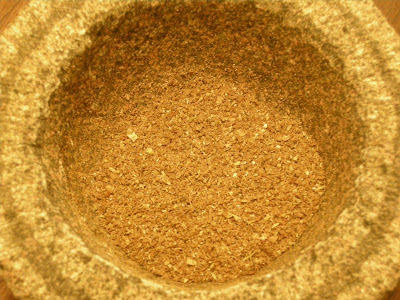
We made the paint with the fennel seeds.


He already knows how to make the paint, so he is doing all this without the help of Maki.


The brown paint is made with star anis.
The yellow-brown paint is made with fennel seeds.


He didn't want to paint further with the fennel.
"I don't like the scent."


The bottles for the paints.

1.3.08

the scent of Stasi smell jar

For the scents exhibition "If there ever was" taking place at Reg Vardy Gallery in Sunderland, U.K., I've developed the scent of Stasi smell jar.

The eastern Germany state secret police Stasi was collecting the scents of the citizens for ttracing the scent of the spy.


I'm developing my own 'palette' from the scratch.


Extracting from the smelly materials.


Making the test composition.


Like at the perfumery school in Grasse, I've developed the formula using the computer.
At the 4th try the scent was getting pretty close to what I've wanted to achieve.
My reference was the book written by the perfumer Takashi Suzuki (Takasago International), but mainly I've trusted my intuition, inspiration, and my experiences. My strong belief was in the fact "You smell of what you eat".

This part of the fragrance was made for the exhibition catalogue. The scents will be printed into the form "scratch & sniff". From now on I'm going to develop the scent to be exhibited.

an apron made of the kitchen clothes


25.2.08

making the scented paint

Today we'll make the scented paint with star anis.

The recipe for making the paint comes from this site.


"It's like a star"
"Yes, and it smells great isnt' it?"


Grinding the star anis till it becomes powder.


The bigger mortal is heavier but easier for him.


10 minutes later


Separate the powder...


Add the milk with the pipet


Sen adds milk, and I mix. Good collaboration.


"Yummy!"


"It looks like a poop..."


It became now a paste.


The paper for the water color seems to deliver the better results.


Did you draw...what?


Now we'll see how long we can conserve this.


The materials for the aprons.

composing the garam masala - preparing for the cildren's workshop

Together with the media artist Krsitina Andersen, we are preparing the children's workshop taking place as a part of the festival "Babylut" in Belgium in the beginning of March.

The festival targets the age 0 - 4. That's unusual as a festival! Those are the ages that the verbal communication does not work completely yet. But therefore the communication by means of scent could be more refined and pure...

Our goals:

  • Let the kids enjoy grinding the spices and the scent that comes up by that movement
  • Let the kids paint with the 'scented paint'.
  • Provide the kids those 'scent memories'. The scented painting helps them reminding the experiences.


What to choose as a palette ...?


We'll make the original aprons for the kids.


As starting the experiments, we'll make the garam masala.
The recipe is from my aunt that regularly practices yoga in South India.

Top row from the left: cumin, coriander seed, green cardamon, clove
Bottom row from the left: black pepper, fennel, laurier leaves, cinnamon


Roasting them.
By heating up, the smell molecules can easily come out from the tissues.


Grind them.


Good job!


We should count that:
  • the heavier stone is easier for the kids
  • the spices flies
  • better to do it on the mat


The dinner was the spinach and goat cheese curry. Delicious.


7.2.08

the absolute of hyacinthus

With using the most common extraction technique I've extracted hyacinthus and made the absolute.

21/01/2008


27/01/2008


31/01/2008


03/02/2008


With this method the extraction can take place in the room temperature, that means that the scent becomes closer to the real scent. It's concentrated, so it is preservable.