11.4.09

workshop@WDK day 1&2

day 1

  • introduction
  • slideshow (about my works)
  • what is smell? what is smelling? how does the sense of smell works?
  • fieldwork assignment
[assignment]
1. Sniff around in the City of Rotterdam
2. Find an interesting smell, and collect the material (if possible)
3. Describe about the smell without mentioning its name.
4. Locate the smell & description on the Google Map


Day 2

Show us the smells that you've found.

Describe the smell. Good or bad? Let's get a step further. You can express it by color, shape, feeling, or texture. Use adjetives. You could also describe it with your personal memories and emotions.


From left: street bush, lavender, clay, barbie that smells somehow


Moss /mud - the smell of Rotterdam Haven


Dead fish - the smell of central market


Dog pee.


Tobacco - the smell that overwhelms around WDK


Old book - the smell of antique shop


Hair - the smell of hair salon.

The students collected a lot of smells related to living. Very good direction.

We'll start extracting the smells.


He is extracting the smell of cement.


Eau bain-marie.


Demonstrating the distillation equipments.
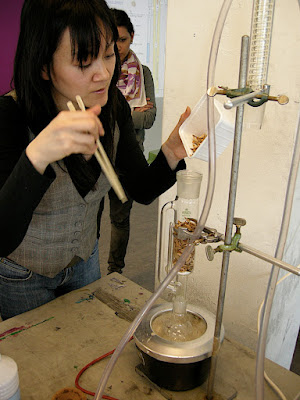

Extracting the smell of camphor tree.

After finishing the day, the students got the 2nd fieldwork assignment (the same as the 1st one).

---
Amazing that they brought these smells that do not neccesarily smell nice. Is that because they are art students, or is that just because they are young? Anyway I like their senses.

Although the smell of dead fish and dog pee were outstanding, they were not extracted. It's not because of the smell, but the students were more interested to work with the different materials.

However the smell of hair was extracted. Before the extraction it was disgusting to smell if you don't know whose hair it was. But after the extraction it was easier to smell. It is perhaps because the smell does not belong to the original person anymore. Funny!

7.4.09

workshop @ Willem de Kooning Academy - finished

Willem de Kooning Academy
2009 Werkweek
Sense of Smell

The Smell Map of Rotterdam

Photo Album

Here follows some postings about the workshop.

From New Album 09/04/02 19:05

30.3.09

Explore Rotterdam with Your Nose!


View Larger Map

From Tue. 31th of March till Fri. 3rd of April, I'll give a workshop at Willem de Kooning Academie in Rotterdam. It's about exploring the City of Rotterdam with the "nose". Those smells found by students will be updated on this Google Map through the week.


CrossLab projectweek 2009
Willem de Kooning Academie

guest teacher
Maki Ueda


title:

Explore Rotterdam with your nose

keywords:

the sense of smell, smelling, smell as a medium, smell-landscape, smell preservation, extraction of smell molecules from a material, smell composition

contents:

What do you smell if you walk around the City of Rotterdam? The exotic smell of a Toko, the muddy smell of The River Maas, the tasty smell from the bread factory, etc. etc.

What is the character of the smell that you are smelling now? How to describe it? And how to share that smell with someone who is not present? In this project you are going to explore Rotterdam on the level of smell. After a couple of field-works, you are required to make a presentation of the smells that you've found in the city, in one way or the other.

purposes:

– You will (have to) smell a lot
– You learn how to communicate about smell with others
(you learn the basic vocabulary for analyzing and expressing the
character of the smell)
– You learn about how smelling works
– You learn how to capture a smell (in the most simple way)
– You learn how to compose smells (in the most simple way)
– You learn about the smell-landscape of Rotterdam, off course!

week planning:

Tuesday: introduction, discussion on smell and smelling, field-work 1st day
Wednesday: demo of smell preservation, field-work 2nd day
Thursday: field-work 3rd day / preparation for the presentation
Friday: presentation

Working method:

You will work individually or in a small group.

reference / inspiration:

http://www.ueda.nl
http://blog.ueda.nl

12.3.09

experimentation after experimentation

This is the 'roasting tea smell' that I've extracted the other day.


The smell has changed a bit. Milder.

Now I am going to separate the smell part from the fat.


The result is absolute. Very mild absolute.

Now I'm going to experiment with incense making. I've applied the turmeric powder that my aunt made herself.


My son helped me as he was having a vacation from the school.


I've added 50% turmeric to the amount of incense base. It's difficult to burn. Perhaps I should add some charcoal powder.

Now, I'm going to experiment with Jinko / agarwood.


It's very expensive material.


Trying maceration both with oil and alcohol.


Oil-base takes much more time than I thought. Alcohol-base seems to me better.


For fun I've made a creme and scented it with the agarwood essential oil that I got as a sample from AOF. It's very dry and earthy so I've added clove and sandalwood. 3 days later it got rounded and became nice, sexy creme!

5.3.09

review - New York Times Magazine

A review of the exhibition If there ever was is in the New York Times Magazine!

http://www.nytimes.com/indexes/2009/02/22/style/t/index.html#pagewanted=3&pageName=22burr


by Chandler Burr

24.2.09

extracting the roasting smell of tea leaves

On a traditional shopping street in Japan, you often smell the roasting smell of tea leaves. It comes from a tea shop. They use a special machine for roasting and diffusing the smell. Why? To make fresh Hoji-cha (roasted tea) and also to attract the customers off course.

My experiment of today is, how to extract this smell!


The tea leaves in the beginning of roasting diffuse sour-sweet smell like the leaves of cherry blossoms.


Controlling the temperature was not easy.


After 30 minutes roasting.


The natural smell of roasting tea leaves was absorbed in the transparent fat.

This is a classical form of perfume called "pomade".

Neri-ko, the Japanese traditional incense

Neri-ko is a primitive form of incense made from diverse fragrant resin or wood powder that dates back to more than 1000 years ago.

Based on the try-out set released by Kogado, I made Neri-ko for the first time.


Mix the powder well,


then pour plum syrop.


Then make small balls.


Then burn the incense!

'Takimono-awase' is a form of game competing each other's recipe. In the "The Tales of Genji", the oldest romance novel written by Murasaki-shikibu more than 1000 years ago, Genji's wives and lovers competed with their own family recipes. How elegant!

I'm thinking about looking into the traditional recipes that are in "The Tales of Genji".