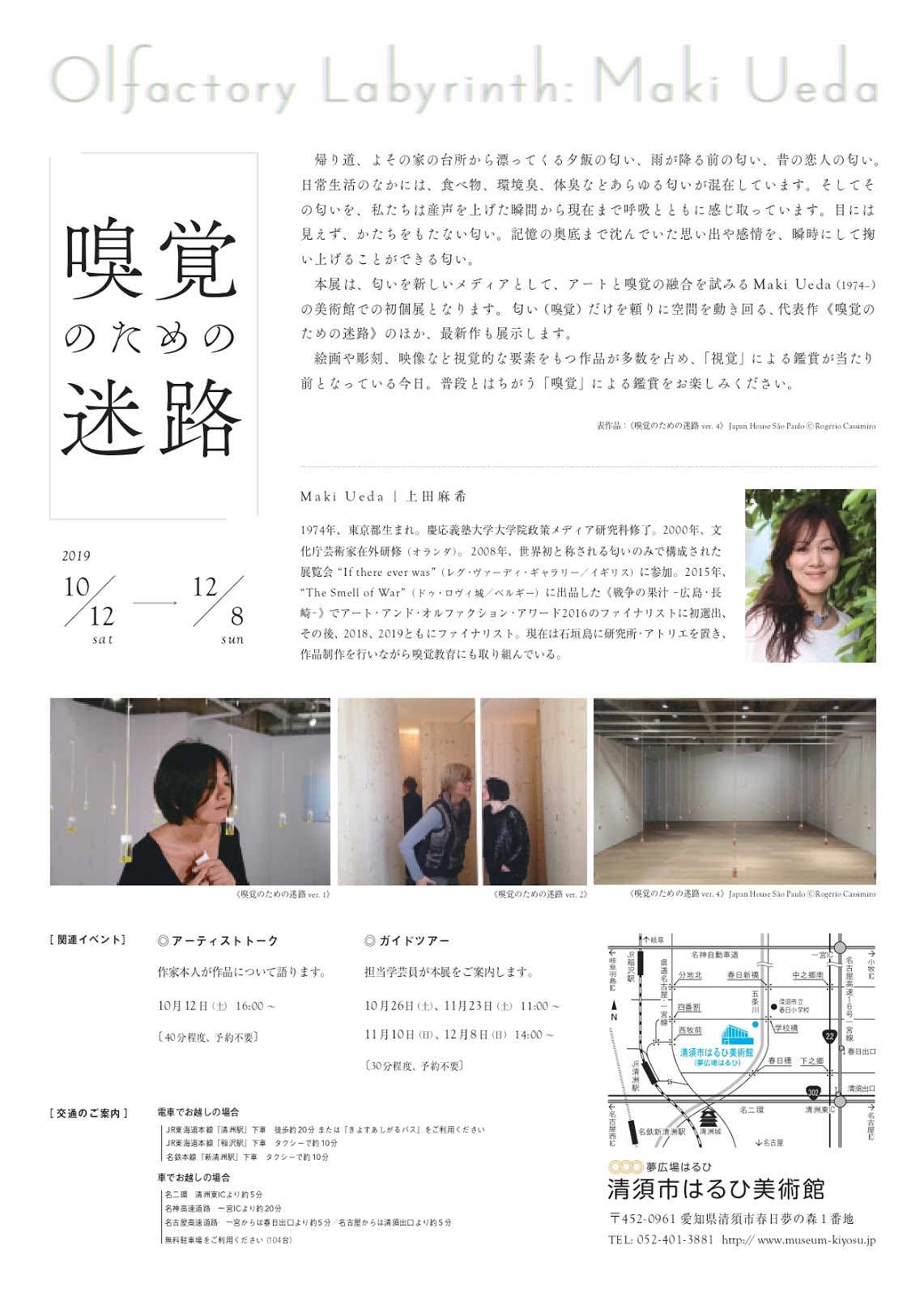
olfactory art / smell art / olfactory installation / smell extraction / the sense of smell and taste experimentations / food art / smell diary
www.ueda.nl for portfolio
Olfactory Art is becoming more, shall we say, visible. There’s Hugo Boss
prize-winner Anicka Yi's “Life is Cheap,” currently at the Guggenheim in
New York, which integrates smell into complex conceptual installations.
Or Peter de Cupere's “Smoke Flowers,” a site-specific work that ran the
opening week of the Venice Biennale. This art isn’t perfume, though per-
fumers may create it. As the discipline develops, questions about com-
position, categorization, and collection arise. Susan Stone met some in
the olfactory art world who are working on the answers.
xxxxxxxx
<AO: My name is Ashraf Osman, and I’m an olfactory art curator. (:04)>
Only a handful of people in the world share that designation with Zurich-
based Ashraf Osman. Olfactory art still has a bit of a stigma, he says, al-
though it’s not as new as we think. The first all-olfactive exhibitions were
in 2008, although elements of it can be found in the work of Damien
Hirst, and Joseph Beuys, and long before that.
<AO: The historical origin of both movements, of conceptual art and ol-
factory art are tied. They both go back to Marcel Duchamp who made it
kind of problematic for every one in the art world to discuss these issues.
He’s someone who took a urinal and flipped it on its back and said this is
art. So after that it was a matter of intentionality (:22)>
Duchamp also created scented installations in 1938, and 1959. With this
rich history, why is olfactory art dismissed?
<AO: Art that is highly regarded is quite political. And there is a miscon-
ception that olfactory art cannot be political. That assumption comes
from its association with perfume. (:11)>
<Sound of tin, packaging>
Artist Maki Ueda opens a small tin holding an even smaller jar. Inside is
one of her latest artworks.
<MU: “So we start from The Juice of War.”>
She dips in a paper smelling strip, and grim smell of decay fills the room.
Ueda created “The Juice of War: Hiroshima and Nagasaki” for the 2015
exhibition The Smell of War, curated by Peter de Cupere.
<OPTIONAL AMBI POST: MU “Don’t worry, I diluted it.” (nb - you can
use the ambi just after this comment to run under the above graph - I al-
ready copied and pasted it in the file>
To evoke the post-atomic-bomb-horror of burnt and decaying bodies,
Ueda used meat to create this powerful scent. Fermenting, extracting,
and distilling, as she has with almost all the work she’s made since she
started in the discipline in 2005. What was then unknown territory now
attracts a crowd:
<MU: “They are ready to smell. Smelling is a very scary thing. You take
molecules into your body. People who came to a visual art exhibition,
they wouldn’t expect to be forced to smell. So at the beginning, it was
really hard.”(:17)>
Ueda’s works are striking and moving, but also unstable, unrepeatable,
unsellable, and un-collectable. Even when bottled and refrigerated,
these extracts only retain their original character for about six months,
she says.
Olfactory art pioneers like Ueda tended to compose their own scents.
Newer artists are now turning to perfumers with industry experience, like
Andreas Wilhelm. Amongst other projects, he created the scents for
Shirin Yousefi’s “The Tales of the Cortex,” shown this spring at Kun-
sthalle Zurich.
<AW: “Of course if I work with an artist they don’t really have an idea
about perfume. They have an idea, like ‘I want to have a firework in a
classroom, and it smells a bit soulful,” and then I try to put this in a bot-
tle. Of course I am following cosmetic regulation, so not everything is
possible.” (:20)>
Wilhelm’s fragrances have registered formulas. They can be replicated,
monetized, and ultimately, collected.
<SWB: “When you work with someone like Andreas, you get better work,
frankly. But when you work with someone like us, you can kind of just do
your own thing. “(:06)>
Saskia Wilson-Brown is the founder of the Los Angeles-based Institute
for Art & Olfaction, which fosters creative work in scent, and also gives
awards for it — to both perfumers and artists.
<SWB: What we try to do is we try to empower the creative person who
wants to work with scent to it to do it themselves. To come in and tinker.
More often than not we end up helping quite a bit.(:17)>
Wilson-Brown is expanding her mission. She held this year’s Art & Olfac-
tion awards in Berlin, and plans to open a branch of her institute here.
The hope is to both encourage more artists, and to further a general un-
derstanding about smell.
<SWB:“If I’m making a piece about, let’s say, religion, and I’m using
frankincense, myrrh, musk, and rose to talk about Islam and Christianity
— pfft — most people won’t be able to pick them apart or know the cul-
tural context or what they mean. So conceptual understanding is three
steps removed. That’s the biggest challenge with olfactory art.”:18) >
Olfactory art continues to become better known, better exhibited, and
more multidisciplinary. Still, scent remains the most mysterious of our
senses; it’s likely its art world corollary will also long be misunderstood.
Tangible Scents - Composition of Rose in the Air - has been shortlisted as a finalist in the Sadakichi Award for Experimental Work with Scent, at the 6th annual Art and Olfaction Awards.
Judged by an international pool of curators, designers, theorists and artists, Tangible Scents - Composition of Rose in the Air - is one of five total finalists in this category.
Awarded to just four perfumes, one experimental scent project and three discretionary awards a year,The Art and Olfaction Awards are designed to raise public interest and awareness around new developments in independent perfumery. The Awards, established in 2014 by the Institute for Art and Olfaction, are given to outstanding creators in the categories of independent, artisan, and experimental perfume from across the globe, chosen for perfumes and experimental projects with scent released in 2018.
The sixth annual Art and Olfaction Awards events will take place in a public ceremony at Oude Kerk on May 2, 2019. Oude Kerk is a historic church founded in 1213, and the city’s oldest building. Located in the heart of Amsterdam’s Red Light district, the space is now one of Amsterdam’s most prestigious cultural centers.
Each Art and Olfaction Award winner will receive The Golden Pear, which continues to cement its status as a prestigious achievement in the perfume world.
Tangible Scents - Composition of Rose in the Air - is an open-air installation which uses Maki Ueda's original method of “de-and re-construction in the air” to decode on the scent of rose. The five major components of the this scent are individually infused into vats of soap, which will each be poured into five different bubble machines. You can deconstruct rose into its component scents by poking the bubbles, or immerse yourself in the total scent. (curator: Aersen Lease, artistic director for the Reed Arts Week Festival 2018)
Olfactory artist Maki Ueda (JP/NL) considers smell a ‘new media’. In her practice, she minimizes the influence of other senses in order to center the spectator’s attention on her fragrant gestures. In addition to her own creative work, she has also taught a course on olfactory art at the ArtScience Interfaculty of The Royal Academy of Art, The Hague (NL) since 2009. While Ueda is currently based in Okinawa, Japan, she works all over the world.
The Art and Olfaction Awards was founded in 2012 as an independent awards mechanism designed to celebrate innovation and excellence in artisan and independent perfume, and experimentation in scent within arts practices. The Art and Olfaction Awards are a program of The Institute for Art and Olfaction, a 501(c)3 non-profit based in Los Angeles, CA.
Presenting partner: IFF
Partners: Lucky Scent / Scent Bar, Pochpac, Perfumer’s Apprentice, Discount Vials, Esxence Scent of Excellence, Nez – La Revue Olfactive, Scent Culture Institute and Autumn Seventy Design Studio.
The Institute for Art and Olfaction is a 501(c)3 non-profit based in Los Angeles, CA.The Institute for Art and Olfaction advances public and artistic engagement with scent.We do this by initiating and supporting arts projects that utilize the medium of scent, by providing accessible and affordable education in our experimental laboratory as well as in partnership with institutions and community groups, and by celebrating excellence in independent and artisan perfumery through our yearly award mechanism, The Art and Olfaction Awards.Through these efforts, we extend the world of scent beyond its traditional boundaries of appreciation and use.
The 2018 artistic directors of Reed Arts Week are enthralled to present this year’s festival: Sensation. This theme can be interpreted in a plethora of ways, including, but not limited to bodily, media-based, and religious sensations. We recognize that the art world often prioritizes our vision, and, through the theme of sensation, we are encouraging artists and patrons alike to challenge this axiomatic primacy of sight in exchange for an interest in collective, spiritual, and somatic resonance.
While the title of our festival employs the word “art,” we are emphasizing the interdisciplinary nature of Sensation. Both student and professional artists will appropriate campus as stage and scenery for poetry readings, dance pieces, theatrical and other performance works, live music, and, of course, the display of visual art. Featured artists and performers include: international olfactory artist Maki Ueda; poet Marty McConnell; fashion designer Eda Yorulmazoglu; animator Eric Dyer; artist Stephanie Gervais; poet Esther Belin; photographer Parker Day; 11:Dance Co.; photographer DJ Meisner; and musical performers Marquii and DJ Manny Petty.
This year’s Reed Arts Week will take place from November 15 – November 18, 2018, on Reed College campus. While a group of Reed faculty initially introduced Reed Arts Week in 1990, the festival has come under the jurisdiction of students and this is the first year in which the annual event will be institutionally stewarded by the Douglas F. Cooley Memorial Art Gallery. All events are free and open to the public.
I'm pleased to announce that my course Olfactory Games (Smell and Art) has become a finalist in the 5th Art and Olfaction Awards.
This time I didn't submit my own work but "a course". I never expected that it would make it, to be honest. I appreciate the judges that made a unique decision. Applause to my colleagues at ArtScience, and all the students who participated in the course! We never stop creating new games.
Some of the students will give presentations at the pre event Experimental Scent Summit on 18-19 Apr 2018 in London. Award ceremony (gala) is on the 21st of Apr.
photo: Lucia Guglielmetti
Olfactory Games
Maki Ueda started her olfactory art course Smell and Art in 2009 at the ArtScience Interfaculty. In the course students learn a conceptual and abstract approach to the medium of smell. The use of smell goes beyond the representational use and focuses on its qualities and experience without a need for a narrative or context. The students are challenged to develop olfactory games using this approach. Furthermore, they learn chemical skills by extracting and composing smells to support their creations. The game format challenges our imagination: while we always have limited fragrance materials, we never stop thinking of new games. The Japanese traditional olfactory game Kodo is a good example of this.
Maki Ueda is an olfactory artist who explores olfaction with an abstract and conceptual approach. She was the World Technology Awards finalist in 2009 (category: art), and the Art and Olfaction Awards finalist in 2016 (Sadakichi Award). She is a guest teacher at ArtScience Interfaculty of the Royal Academy of Art and Royal Conservatoire, The Hague, The Netherlands. Maki Ueda is currently based in Okinawa, Japan. www.ueda.nl
Course conception: Maki Ueda
Participating students: June Yu, Lauren Jetty Howells-Green, Kay Churcher, Sophia Bulgakova, Ana Oosting, Abel Fazekas, Ilia Lukovnikov, Vera Khvaleva, Sunna Svavarsdottir, Mischa Lind, Stefano Zucchini, Georgia Kosmatou, Koen de Groot, Tudor Ulrich, Anni Nops, ...and all the students participating in the past courses.
Course given at: ArtScience Interfaculty of the Royal Academy of Art and Royal Conservatoire, The Hague, The Netherlands
MILAN— We are pleased to announce the nominees for the 2018 Art and Olfaction Awards, which we made public in a special press event at Esxence, in Milan, on April 5, 2018.
Awarded to just four perfumes, one experimental scent project and two special awards — the Aftel Award and the Contribution to Scent Culture — a year, The Art and Olfaction Awards are designed to raise public interest and awareness around new developments in independent perfumery. The Awards, established in 2014 by the Institute for Art and Olfaction, are given to outstanding creators in the categories of independent, artisan, and experimental perfume from across the globe, chosen for perfumes released in 2017.
The fifth annual Art and Olfaction Awards events will take place in a public ceremony at The Tabernacle. Continuing the tradition of holding the awards in unique locations in different perfume capitals of the world, the Tabernacleis a Grade II-listed building in Powis Square, Notting Hill, west London, England, built in 1887 as a church and converted into an arts center in the 1970s.
Each Art and Olfaction Award winner will receive The Golden Pear, which continues to cement its status as a prestigious achievement in the perfume world.
As with past years, our panel of esteemed judges includes luminaries from the perfume and art worlds. The members of the Art and Olfaction Awards 2018 jury include: Andy Tauer (Switzerland), Antonio Gardoni (Italy), Christopher Gordon (USA), Grant Osborne (UK), Harald Lubner (Germany), Josh Meyer (USA), Sarah McCartney (UK), Andreas Wilhelm (Switzerland), Bibiana Prival (USA), Dana El Masri (Canada), Dawn Spencer Hurwitz (USA), Matthias Janke (Germany), Ulrike Knöll (Germany), Spyros Drosopoulos (Netherlands), Cristiano Canali (France/Italy), Denyse Beaulieu (France), Helder Suffenplan (Germany), Jeanne Doré (France), Katie Puckrik (England), Luca Turin (Greece), Mark Behnke (USA), Ashraf Osman (Switzerland), Caro Verbeek (The Netherlands), Darin Klein (USA), Sarah Baker (England), Simon Niedenthal (Sweden)
Zoe Crosher (USA), Frederic Jacques (USA), Hall Newbegin (USA), Mandy Aftel (USA)
The Art and Olfaction Awards was founded in 2012 as an independent awards mechanism designed to celebrate innovation and excellence in artisan and independent perfume, and experimentation in scent within arts practices. The Art and Olfaction Awards are a program of The Institute for Art and Olfaction, a 501(c)3 non-profit based in Los Angeles, CA.
The Art and Olfaction Awards could not exist without the generous support of our partners at Lucky Scent / Scent Bar, Pochpac, Perfumers Apprentice, Esxence, Barrister and Mann, Aftelier Perfumes, Nez – La Revue Olfactive, Basenotes, ÇaFleureBon, AutumnSeventy, Perfumed Plume Awards.
The Institute for Art and Olfaction is a 501(c)3 non-profit based in Los Angeles, CA.The Institute for Art and Olfaction advances public and artistic engagement with scent.We do this by initiating and supporting arts projects that utilize the medium of scent, by providing accessible and affordable education in our experimental laboratory as well as in partnership with institutions and community groups, and by celebrating excellence in independent and artisan perfumery through our yearly award mechanism, The Art and Olfaction Awards.Through these efforts, we extend the world of scent beyond its traditional boundaries of appreciation and use.
Smell courses in art academies: fresh perspectives
More and more art students (the Royal College of Art, the Hague, the Royal College of Art, London and PXL Mad, Hasselt) are taught how to engage with new and demanding (museum) audiences through the sense of smell.
The Dutch-Japanese artist Maki Ueda has been teaching the course ”Smell and Art” at the ArtSicence Interfaculty at the Royal Academy of Arts the Hague for almost 10 years now. Ueda choose the olfactory game as a starting point because it requires a creative approach, that is neutral in a sense that the quality and nature of the scents are less important than the sense of smell itself:
“From the beginning I made a conceptual and abstract approach to medium of smell […] We always have limited fragrance materials but we never end up with thinking of new games”
Beside challenging her students to playfully explore the limits of our most neglected sense in order to get acquainted with its characteristics and peculiarities, there is also a practical dimension. Students actually learn the basic skills of perfume making:
“There needs to be a poetic aesthetic dimension too. That is why I teach students a somewhat scientific approach to the medium of smell by extracting and composing, in order to entertain their audience in a creative way”